Discover the Model Context Protocol, its technical architecture, its concrete use cases and how to implement it to connect your LLM language models to your data sources and external tools.
Launched by Anthropic in late 2024, this open-source protocol established itself in 2025 as the interoperability standard for AI agents. It is now adopted by OpenAI, Microsoft, JetBrains, and thousands of developers worldwide.
The Model Context Protocol: definition and challenges
The Model Context Protocol (MCP) is an open standard. It enables artificial intelligence applications, including LLM language models, to connect securely and bidirectionally to various data sources and external tools. By standardizing these interactions, the MCP facilitates integration and interoperability between AI models and existing systems.
MCP is a protocol designed like the USB-C of AI applications : a universal connector, regardless of the external service or file system to be connected.
In concrete terms, MCP relies on a relationship between MCP clients (the AI application, the AI assistant or the IDE) and MCP servers (the programs that expose the data or tools).
This standardized client-server architecture allows the same model to query a database, a Git repository or a monitoring tool without ad hoc development.
In March 2025, OpenAI officially adopted MCP in its Agents SDK and development tools, signaling that the protocol was moving beyond the Anthropic ecosystem to become a de facto AI industry standard. (Source: OpenAI, "New tools for building agents", March 26, 2025 - openai.com/index/new-tools-for-building-agents )
Key takeaway: The Model Context Protocol (MCP) is an open-source protocol launched in late 2024 that standardizes communication between LLMs and external data. Its adoption by OpenAI in March 2025 made it an industry standard in less than six months.
Existing MCP servers: a rapidly growing ecosystem
In just one year, the MCP ecosystem has experienced remarkable growth. The official GitHub repository modelcontextprotocol/servers now lists over 1,000 MCP servers published by the community, covering dozens of tool categories and data sources. (Source: GitHub, modelcontextprotocol/servers, accessed March 2026 — github.com/modelcontextprotocol/servers )
Some notable examples among the most widely used MCP servers:
- Git : access to repositories, reading, searching and manipulating files, useful for code analysis or documentation generation.
- PostgreSQL : schema inspection and read-only query execution.
- Redis : interaction with in-memory databases to store and retrieve data quickly.
- Slack : integration with communication channels for real-time interactions — replying to messages, summarizing conversations.
- Sentry : access to error reports and logs to diagnose and resolve software problems.
- Grafana : searching dashboards and querying monitoring data sources.
- MotherDuck : querying and analyzing data via DuckDB, particularly suited to analytical workloads.
On the MCP customer side , adoption has also accelerated. In 2025, VS Code (Microsoft) , JetBrains , Cursor , Zed , and Sourcegraph Cody all announced native support for MCP. Claude Desktop remains the go-to solution for non-developer users who want to connect local tools without writing code. (Source: official MCP documentation, modelcontextprotocol.io, 2025)
Key takeaway: the MCP ecosystem exceeds 1,000 referenced servers by early 2026. The main IDE and AI platform vendors have natively integrated the protocol, making it an operational standard rather than an experimental one.
Technical details of the MCP protocol
MCP follows a client-server architecture similar to the Language Server Protocol (LSP). Here are the main technical aspects:
Architecture: The client is typically an AI application, an AI assistant, or a development environment. The server is a program that provides access to specific data or tools, local files, a database, an external service, or a third-party API.
Communication: Requests and responses are encoded according to the JSON-RPC 2.0 specification . Communication between clients and servers is via stdin/stdout (for local processes) or HTTP with Server-Sent Events (for remote deployments).
Evolution of the specification: The MCP specification has evolved since its launch. Version 2025-03-26, published in March 2025, notably introduces support for OAuth 2.1 for secure authentication of remote MCP servers, a prerequisite for deployments in enterprise environments. (Source: Model Context Protocol Specification, spec.modelcontextprotocol.io, version 2025-03-26)
Official SDKs Development kits are available in Python , TypeScript, Java and Kotlin , covering the majority of enterprise environments.
Key takeaway: MCP is an open, documented, and actively maintained protocol. The addition of OAuth 2.1 in the 2025-03-26 specification removes the main obstacle to its enterprise adoption: securing connections to remote servers.
Use case: Querying a PostgreSQL database via MCP from a business chat
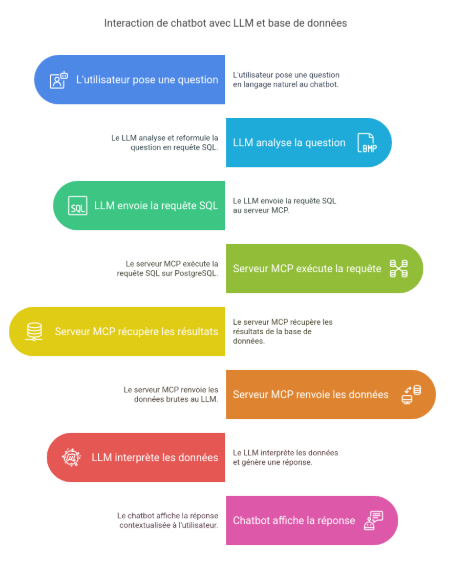
Objective: to allow a business, sales, HR, logistics user to ask a question in natural language in a chat and get an answer based on real-time data from a PostgreSQL database, thanks to the Model Context Protocol .
Steps in the process
- The user enters their question in the chat interface (e.g., "Which orders are late this week?" ).
- The AI assistant forwards the request to the MCP PostgreSQL server.
- The MCP server translates the query into SQL and queries the database in read-only mode.
- The result is returned to the LLM, which formulates a response in natural language.
- The user receives a contextualized response, without direct access to the database.
Advantages of this approach
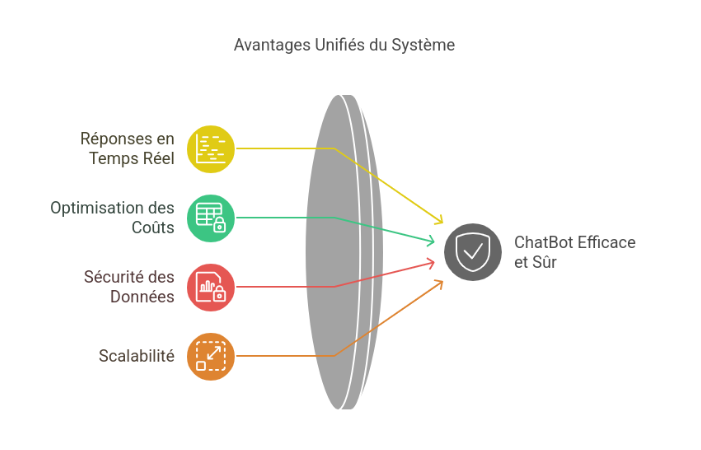
- Real-time data : no need to retrain the model or export data.
- Cost optimization : less context to inject into prompts.
- Security : PostgreSQL protects sensitive data via existing permissions; the addition of OAuth 2.1 in the MCP spec further strengthens this point for remote deployments.
- Scalability : MCP allows adding other databases or APIs without redesigning the architecture.
Key takeaway: This use case illustrates how AI agents can access external business data in real time without exposing the underlying systems or modifying the models. This is precisely the type of architecture that IT teams will favor in 2026 for their generative AI projects in production.
How to implement an MCP server?
Here are the steps to deploy your own MCP server :
- Choose your language : Python and TypeScript are the most mature and best-documented SDKs. Java and Kotlin are available for enterprise environments.
- Use the official SDK : it provides the tools to manage the required communications and data structures.
- Define the capabilities : what data or actions will your server expose? (reading local files, SQL queries, API calls…)
- Implement the methods : develop each capability by following the MCP specification.
- Manage communication : ensure that the server responds to the JSON-RPC 2.0 format and supports the required transports (Stdio or HTTP/SSE).
- Securing access : For remote deployment, implement OAuth 2.1 in accordance with the specification version 2025-03-26.
- Test and deploy : validate the behavior of your server before putting it into production.
An MCP server will allow you to connect your data sources, business applications, databases, file systems, to your LLM in a standardized and secure way.
Key takeaway: Implementing an MCP server doesn't require advanced AI skills. SDKs available in Python and TypeScript allow for a quick start, even on existing environments. The addition of OAuth 2.1 in the 2025 specification also simplifies securing production deployments.